Communication creates access
Every student receives consistent access to total communication. AAC, speech, sign, symbols, gestures, eye gaze, movement, facial expression, and behavior are recognized and supported throughout the day.
Our educational philosophy
Students learn when they can communicate, regulate, move, connect, practice meaningful skills, and use those skills in real life. At Brooks, education and therapy work together throughout the day so learning leads to greater independence, belonging, and contribution.
We start with the student
We begin by asking who this student is: What are their strengths? What do they enjoy? What do they want to learn? What do they want to become? What is most critical for them to learn right now?
The answers help the student, family, educators, and therapists decide what to teach and where to begin. Students may share a classroom and a theme, but their goals, materials, supports, ways of responding, pace, and measures of success do not have to look the same.
The Brooks way of learning
Brooks serves students whose learning may not look traditional. Progress may begin with a glance, a movement, a symbol, a pause, a choice, or a new way to participate. We honor those beginnings and build from them.
Our goal is not to make students perform skills in isolation. It is to help them communicate what matters, participate in daily life, develop relationships, solve real problems, and share their strengths with others.
Every student receives consistent access to total communication. AAC, speech, sign, symbols, gestures, eye gaze, movement, facial expression, and behavior are recognized and supported throughout the day.
We value what a student is trying to accomplish—not whether it looks typical. Students use the communication, movement, and learning strategies that work for their bodies and lives.
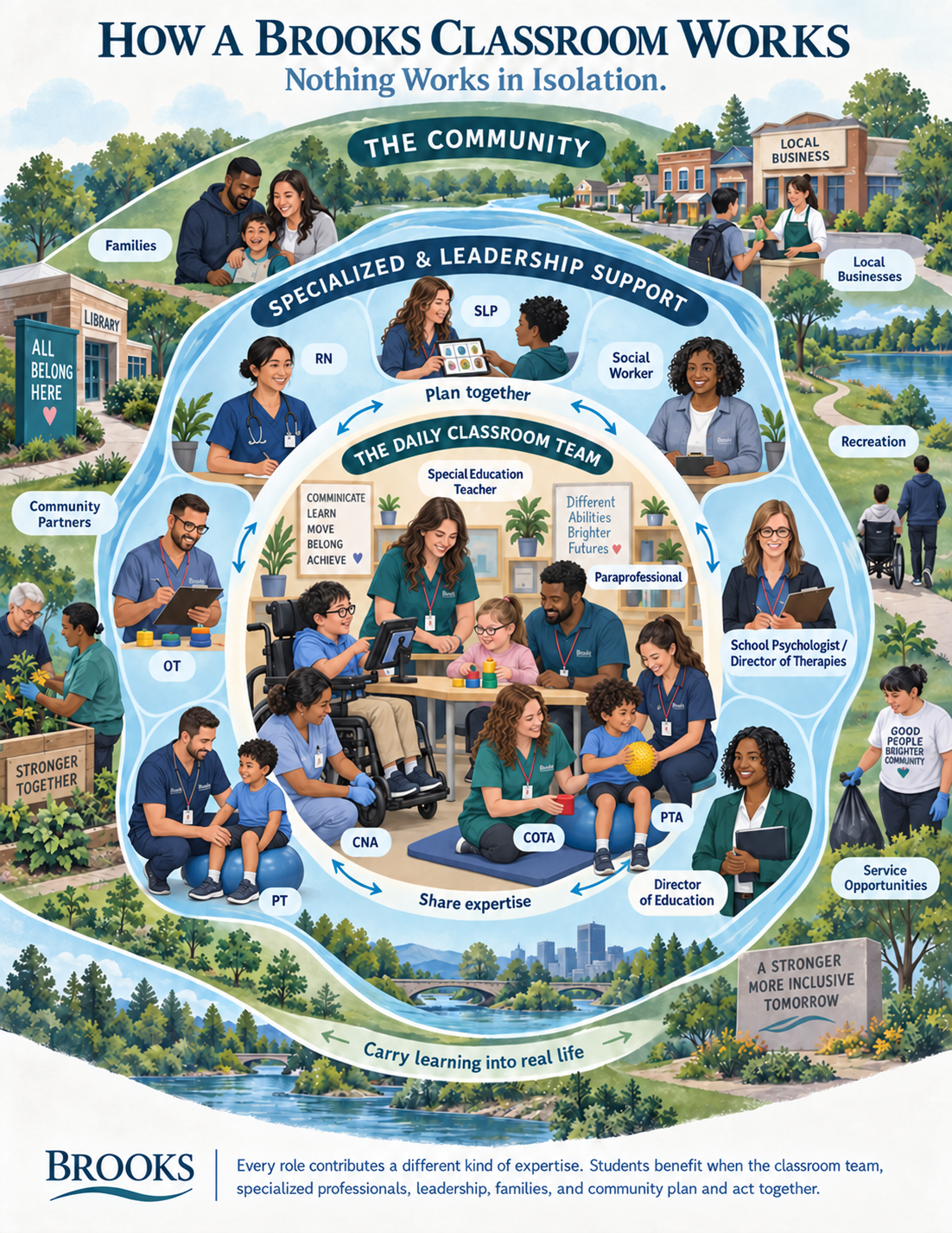
Educators, therapists, nursing staff, families, and students share goals and practice skills across academics, routines, play, meals, transitions, recreation, and community experiences.
Students learn best when they feel safe, connected, and ready. Adults regulate, relate, and then reason—building support around the student rather than expecting learning through distress.
Skills are taught repeatedly in the places they are actually needed. Supports are adjusted thoughtfully so students can participate more fully and rely on others less over time.
Academic learning connects to communication, self-care, relationships, leisure, work, home, and community. Success is measured by improved quality of life and meaningful participation.
Explore education at Brooks
Each area has its own page with the specific frameworks, curricula, routines, and experiences Brooks plans to use.
Our foundation
Learning begins when students have reliable ways to express themselves, understand others, make choices, and participate.