
Regulate. Relate. Reason.
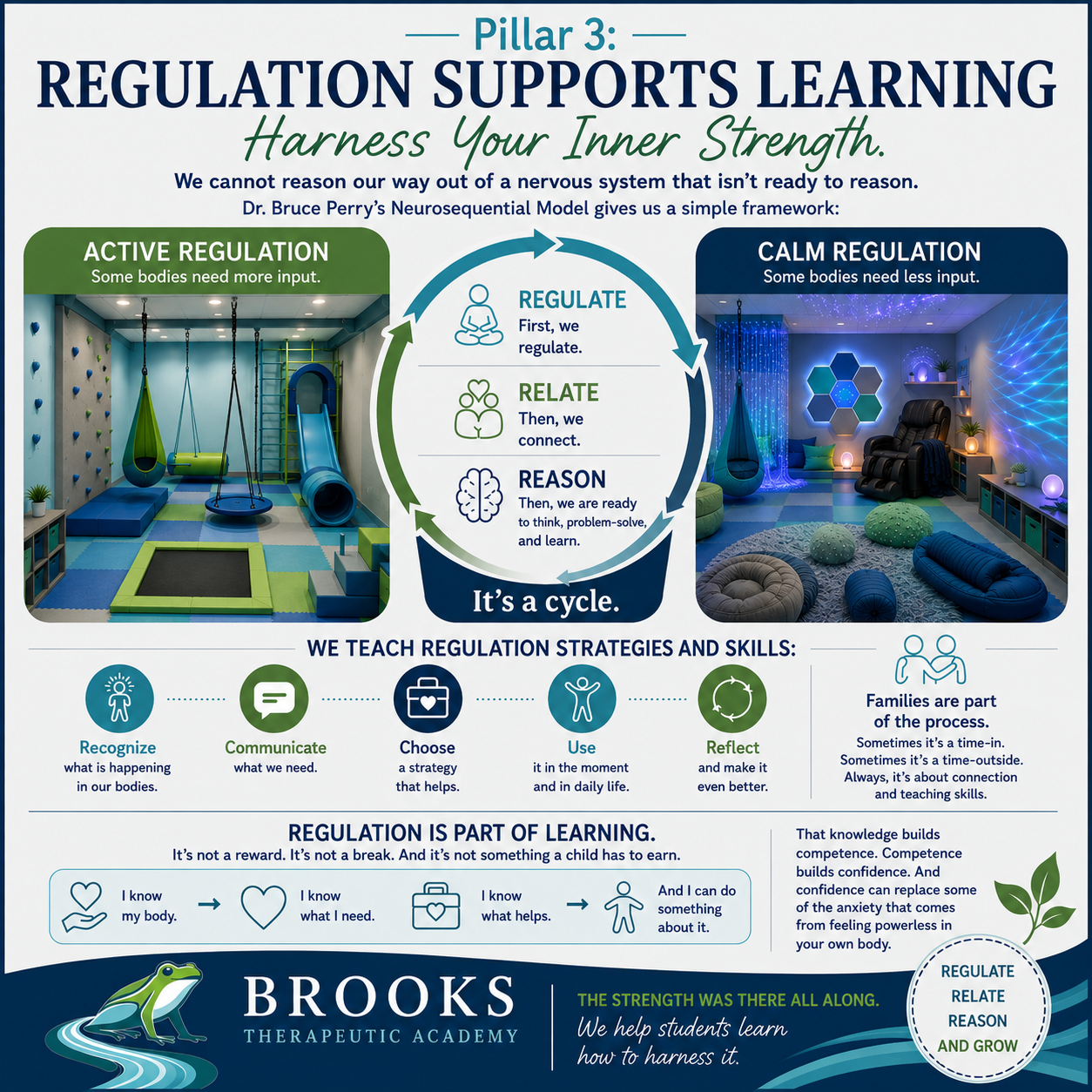
Brooks draws on the work of child psychiatrist and neuroscientist Dr. Bruce Perry. His sequence reminds adults that higher-level reasoning is not the starting point: safety and regulation support connection, and connection makes learning more available.
At Brooks, we also understand this as a continuing cycle. Regulation promotes relationships. Secure relationships promote learning. Practice, competence, and successful learning then strengthen a student’s capacity to regulate in the future.
Movement throughout the day
Walking, adaptive cycling, active play, stretching, and purposeful movement are planned parts of learning.
Individual sensory supports
Students may need alerting input, calming input, reduced stimulation, deep pressure, vibration, or a quiet place to recover.
Two kinds of sensory space
An active room supports movement and engagement; a calming room provides lower-energy tools for rest and organization.
Communication before escalation
Students receive ways to express discomfort, ask for a break, request movement, refuse, and seek help.
Behavior communicates a need.
Adults seek to understand what a student’s behavior is communicating rather than relying on punishment. The team adjusts the environment, teaches alternatives, and builds skills that help the student participate safely and successfully.