The need is here.
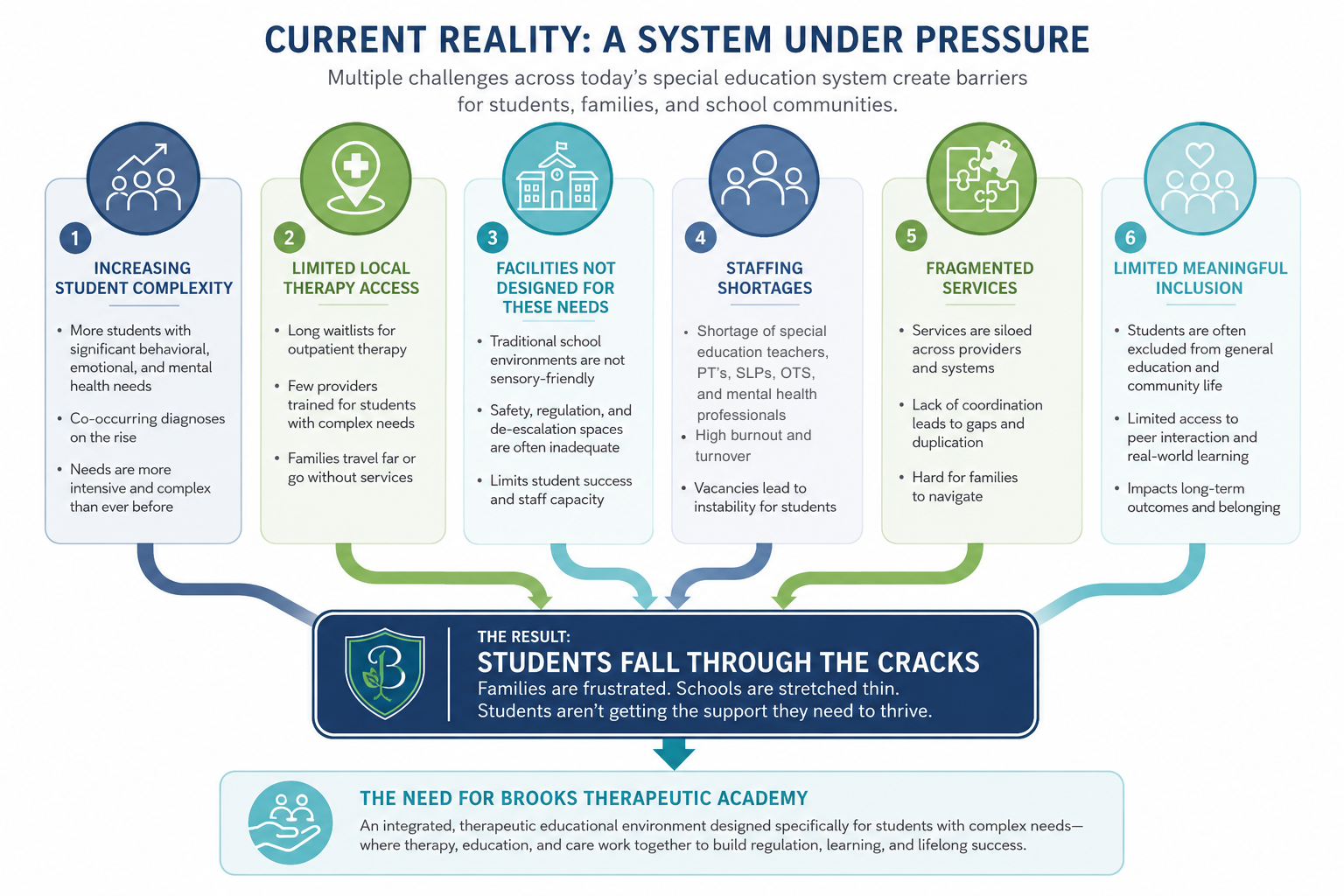
Adams County has pediatric therapy providers and dedicated public-school professionals, but important gaps remain. Medical therapy may involve long wait times or access barriers. School-based therapy appropriately focuses on educational access, which means some mobility, positioning, endurance, self-care, and functional needs may fall between educational and medical systems.
Specialized private placements in western Illinois are limited. Programs most comparable to the Brooks vision are concentrated around the Chicago metropolitan area, several hours from Quincy. Daily travel is not realistic, and residential placement can separate students from the families and communities that know them best.
A conservative review identified at least nine elementary-aged and five junior-high-aged students in the Quincy area whose educational, therapeutic, communication, and medical support needs closely align with the proposed Brooks model. The regional need extends into surrounding rural counties, where specialized staff, equipment, facilities, and multidisciplinary services can be even harder to access.
Families carry the coordination
Education, therapy, medical care, equipment, insurance, transportation, and advocacy often remain disconnected.
Districts face growing complexity
Local teams work hard, but traditional schools were not built as comprehensive therapeutic environments.
Distance limits real choice
Some families consider leaving established jobs, providers, relatives, and support networks to find services.
Our region can become the answer
Brooks aims to make Adams County a destination for specialized education and family support.
Experience shaped the response.
Brooks did not begin with a building plan. It grew across more than twenty years of learning from people with disabilities, their families, teachers, therapists, caregivers, advocates, and communities.
In Iași, Romania, children living in an orphanage made visible what happens when care is separated from relationship, dignity, communication, and belonging. In adaptive recreation, art, and dance programs in Salt Lake County, participants showed how movement, creativity, and shared joy can reveal strengths that traditional settings overlook.
At Camp Kostopulos, campers, families, volunteers, and staff demonstrated what becomes possible when adventure and community are made accessible. Work as a teaching assistant, paraeducator, and special education teacher brought lessons from classrooms, aquatic therapy, adaptive physical education, personal care, communication, mobility, and daily life.
Students and families kept teaching.
Students in Utah and Illinois showed that therapy cannot be separated from the moments when a skill matters. Families showed the burden of coordinating education, medical care, equipment, insurance, transportation, therapies, advocacy, and ordinary family life. Foster care brought an even deeper understanding of how safety, attachment, trauma, regulation, systems, and family support shape a child’s ability to learn and trust.
Brooks is built from the conviction that children should not have to fit themselves into systems that were never designed around them.
And then there was Alvin Lee Brooks.
Before there was Brooks Therapeutic Academy, there was a little boy named Alvin. His life continues to shape the heart of this work and the name it carries. Brooks honors him through a school grounded in the belief that every child has value, every child can learn, and every child deserves the opportunity to communicate, belong, participate, and build greater independence.
A vision carried by many people
No single person created the Brooks Model alone. It reflects lessons shared by students who communicated without speech, parents who refused to stop advocating, siblings who learned compassion and responsibility early, educators who kept adapting, therapists who brought expertise into real life, medical professionals who helped children participate safely, and community members who made room for genuine belonging.